The Akhisar Museum: Archaeology and Ethnography at the Crossroads of the Aegean
Once upon a time, this building heard the cries of a mother who had lost her son, then the echo of school bells, and later the silence of the empty corridors of the teachers’ residence. Today, a very different clock ticks beneath its arches—a clock spanning millions of years. The Akhisar Museum (Akhisar Müzesi) stands opposite the ruins of ancient Thyatira, in the province of Manisa, and the moment a visitor crosses the threshold, a journey begins—from 18-million-year-old fossilized shells to the silver seals of the Ottoman Empire. The Akhisar Museum is not a massive metropolitan behemoth, but an intimate 650-square-meter space housing 689 exhibits, each of which was literally unearthed from the soil of the Aegean coast. This is precisely what makes it one of the most authentic regional museums in Western Anatolia: nothing is brought in from elsewhere; only items belonging to the Akhisar Plain itself are displayed here.
History and Origins of the Akhisar Museum
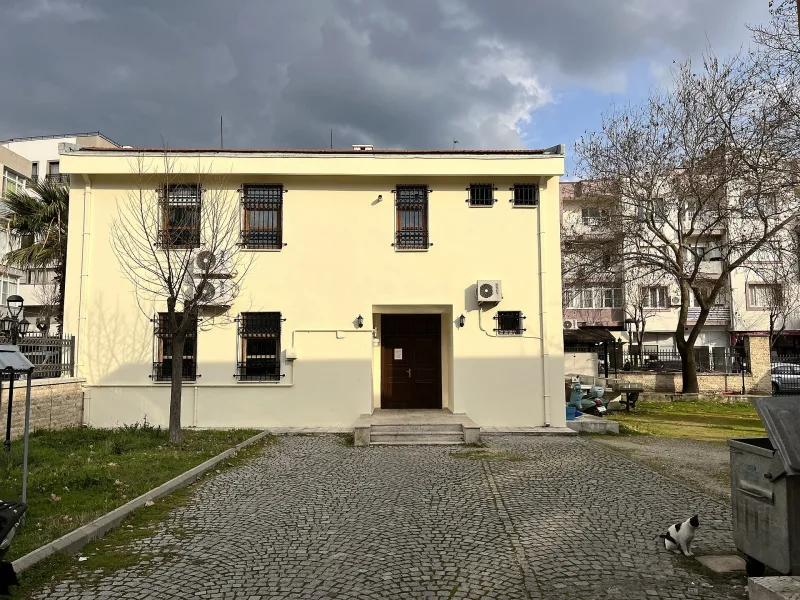
The museum’s history is unexpected because the building predates its use as a museum—and therein lies the main drama of the site. In 1932, a wealthy resident of Akhisar, Ayşe Aloglu, commissioned the construction of a two-story hospital in memory of her son Ali Şefik, who died at a very young age from an illness. The clinic was named after him—"Ali Şefik Hospital"—and did indeed treat patients for several years. Then, at the request of local officials and with Ayşe’s consent, the building was transferred to the Ministry of National Education and turned into a secondary school bearing the same name. This continued until 1992.
After renovation in 1994, a teachers’ residence—Ali Şefik Öğretmenevi—opened here. In 2005, the authorities decided to close this facility, sparking heated controversy: the Akhisar branch of the Eğitim Sen union accused the administration of political motives and led people into the streets. In response, officials announced that the building would become a museum—and that this would enrich the city’s cultural heritage. However, the teachers’ house did not close permanently until 2007, and the promised transformation dragged on for many years.
There were several reasons why Akhisar specifically needed its own museum. First, the storage facilities of the Manisa Archaeological Museum were overflowing—there was nowhere to display artifacts from ongoing excavations. Second, the city lies at the intersection of the Istanbul–Izmir and Bergama–Denizli tourist routes, and nearby is ancient Thyatira, one of the seven apocalyptic churches of the New Testament. The initiative was taken by Kefayettin Ez, then head of the Culture and Tourism Commission of the Manisa Provincial Assembly. On September 4, 2006, the site was officially designated for the future museum.
The tender for restoration began in 2007, with a total budget announced at 2.1 million lira. But the construction site delivered an unpleasant surprise: as soon as the plaster was removed from the walls, it became clear that the building had changed beyond recognition over the decades and the approved design was no longer suitable. Technical experts compiled a separate report, and preservation boards demanded new plans. As a result, the second floor had to be dismantled, the tender had to be re-run, and the six-year saga concluded only in May 2012 at a final cost of 1,537,897 liras. On May 18, the museum opened its doors to the public, and on August 6, 2012, it was officially inaugurated by Ertuğrul Günay, Minister of Culture and Tourism.
Architecture and What to See
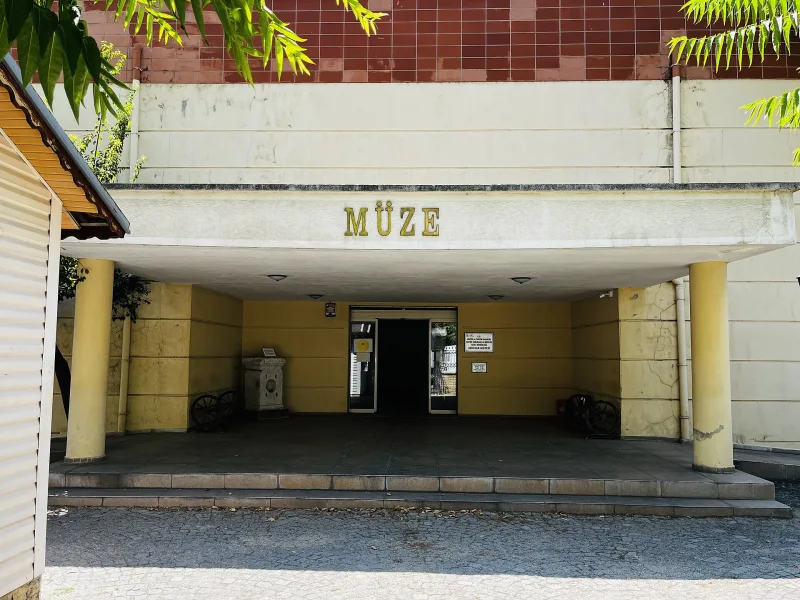
The museum complex is arranged as a group of independent buildings within a shared garden: the exhibition building itself, an administrative building, and a separate storage facility. The exhibition building itself is a single-story, rectangular structure with a floor area of 650 m². An open-air exhibition covering 1,250 m² has been set up in the garden, where artifacts can be viewed under the Aegean sky. From the outside, the building looks restrained, almost ascetic, with characteristic stone masonry and simple, rhythmic windows—a reminder that 1932 was a time of the early Republic, when utilitarian aesthetics were valued above ornamentation.
Inside, the exhibition is divided into two large sections—archaeology and ethnography—and within the ethnographic space, a special section called “Arasta” is dedicated to crafts and trade.
Archaeology Section
The section spans a timeline from the Bronze Age to the Byzantine Empire. At the entrance, visitors are greeted by fossils from the Soma coal mines, dating back approximately 18–11 million years—exhibits that immediately shift the conversation to a geological scale. Further on are marble idols and stone artifacts from Kulaksyzlar dating to the Chalcolithic era—delicate, almost schematic silhouettes reminiscent of early Cycladic figurines.
A special place is reserved for the pottery of the Yortan culture, discovered in the early 20th century by the French engineer Paul Godin in the village of Bostanci (formerly Yortan) near Akhisar. These black and gray-brown vessels with their characteristic beak-shaped spouts are a hallmark of the Early Bronze Age in Western Anatolia, and it is here that they can be seen in their original context.
The Lydian period is represented by gold and silver from tumulus burials. Nearby are five Attic lekythoi from the 5th–4th centuries BCE: two vases with mythological scenes and three with palmettes, delicate black-figure and black-glaze work, reminding us that the Aegean coast was part of the broader Greek world. The highlights of the section are a gold figurine of a ram from the village of Gökçeler and the “Relief of a Youth” (Gökçeler kabartması) from the Archaic period, found in the same location. It is a concise yet surprisingly vivid work, in which a young face gazes through twenty-five centuries.
The Roman and Byzantine periods are represented by ceramics, glass vessels, unguentaria (small bottles for perfumes), metalwork, ossuaries, and jewelry. Four Latin inscriptions—honorary and funerary stelae—allow us to read the names of Thyatira’s long-departed citizens. A separate display case is dedicated to coins: from the Archaic period to the Ottoman era, with a special focus on coins minted in Thyatira.
Ethnography Section and Arasta
The ethnography section begins with Seljuk and Ottoman coins, followed by an 18th-century Quran, Ottoman manuscripts, sultan’s decrees, and calligraphic tiles—hüsn-i hat. Seals of the Akhisar municipality, Çanakkale pottery, traditional men’s and women’s costumes, caftans, carpets, and jewelry—all of this tells the story of daily life in a small Aegean provincial town. In the display cases featuring household items, glass jugs, coffee sets, hammam accessories, and hand-embroidered pieces are displayed side by side. A separate section is dedicated to lighting and weapons: oil lamps, pistols, rifles, and sabers of various sizes.
The heart of the ethnography section is the Arasta section. Here, visitors learn about 19th–20th-century tobacco farming, the region’s main industry: boxes for pressing bales, needles for stringing leaves, hoes, and sprayers. Nearby are the tools of tinsmiths, saddlers, and craftsmen who made Akhisar phaetons and horse-drawn carts. A special display case, “Keçeci Orhan,” is dedicated to the local felt maker Orhan Patoglu and his workshop: the felt itself, shepherds’ capes (raincoats), and the tools he used for decades.
Interesting Facts and Legends
- The building was commissioned by a mother—a rare instance where a monumental structure was originally conceived as a “monument to a son.” The Ali Şefik Hospital became a form of remembrance in place of the customary gravestone.
- The current Minister of Culture and Tourism, Ertuğrul Günay, participated in the 2012 opening—the formal inauguration took place on August 6, while the general public visited as early as May 18, on International Museum Day.
- Initially, the exhibition featured 1,051 artifacts; by 2019, the number had been reduced to 689—some items were sent to research repositories and for restoration, making room for the finest examples.
- The Yortan culture pottery, the museum’s pride and joy, was discovered by railway engineer Paul Godin: while laying the Izmir–Kasaba railway line in the early 20th century, he conducted archaeological excavations on the side and took some of the finds back to France.
- The building’s transformation from a hospital to a school, then to a teachers’ residence, and finally to a museum reflects the entire social history of Akhisar in the 20th century: from early Republican-era medicine to education and, ultimately, to culture.
How to get there
Akhisar is a small town in the province of Manisa, approximately 90 km northeast of Izmir and 55 km south of Bergama (ancient Pergamon). For Russian-speaking tourists, the most convenient option is to fly into Izmir Adnan Menderes International Airport (ADB): direct flights from Istanbul take about an hour, and seasonal charter flights operate from Moscow in the summer. From the airport, you can rent a car and drive along the E87/D565 highway for about 1 hour and 20 minutes.
The second option is the İZBAN commuter train and intercity buses operated by companies such as Pamukkale, Kamil Koç, and Metro Turizm: buses run several times an hour between Izmir and Akhisar; the trip takes 1.5–2 hours, and a ticket usually costs a few hundred lira. If you’re planning a combined trip with Pergamon, it makes sense to rent a car for the day: Pergamon—Akhisar—Thyatira—Sardis form a packed but logical itinerary. The museum is located across from the Thyatira excavation site in the city center, about a 10-minute taxi ride from the bus station (Otogar).
Tips for travelers
The best time to visit is spring (April–May) and fall (September–October): the Aegean sun isn’t too harsh yet, and it’s pleasant to explore the open-air exhibition in the museum garden. In summer, temperatures often exceed 35°C, and even a short walk through the Thyatira ruins across the street can be exhausting. In winter, rain and wind make the city less photogenic, but there are practically no tourists.
Allow 1.5 hours for the museum itself—that’s enough to leisurely explore both sections and the Arasta, view the “Relief of a Youth” and Lydian gold, and examine the collection of Thyatira coins. Add another hour for the ancient site across the way, where you can see the remains of a colonnade, a basilica, and a commercial street. For Russian-speaking visitors accustomed to the scale of the Hermitage or the Pushkin Museum, the atmosphere will be different, more akin to provincial local history museums in Russia: compact, quiet, with detailed labels in Turkish and English. It’s helpful to know some key Turkish terms in advance: müze — museum, arkeoloji — archaeology, etnografya — ethnography, sikke — coin, kabartma — relief.
Photography is usually permitted in the galleries without a flash or tripod, but check with the attendant just to be sure. At the entrance, there is a small shop with catalogs and souvenirs—a nice little touch for those who want to take a piece of Akhisar home with them. Be sure to stop by the old city bazaar, just a few minutes’ walk away: Akhisar is famous for its olives (they produce some of Turkey’s best table olives here), and the local “siyah zeytin” makes for a wonderful culinary souvenir. Bring water, comfortable walking shoes for exploring the Thyatira excavation site, and a light scarf for women—it will come in handy if you want to visit the nearby 14th-century Ulu-Cami mosque. The Akhisar Museum is small, unpretentious, and rich in content; it doesn’t pretend to have the glamour of a capital city, but it offers a rare sense of a direct connection to the land where, over three thousand years, the Hittites, Lydians, Greeks, Romans, Byzantines, Seljuks, and Ottomans have succeeded one another—and each of these eras has left behind a display case here that you can see with your own eyes today.